

Faith Communities
To Save One Life is mobilizing faith communities across America to make this vision a reality through education, partnership, and the shared conviction that saving a life is sacred work.
Together, we can achieve our goal of encouraging more living kidney donations.


By joining the To Save One Life campaign, your congregation can help us educate people and spread the message: Avoid daily dialysis by getting a preemptive kidney transplant, living kidneys work faster, better, and longer than deceased organ kidneys, and a person who needs a kidney doesn’t need a match. They just need a donor of any blood type – anyone healthy enough to donate on their behalf in a kidney “swap.”
Why Faith Communities?
“As far as I know, kidneys are not religious.”
— Ron Wolfson, Founder, To Save One Life
Congregations are not just a channel for this work. They are its most natural home.
Most current donors are people of faith.
The National Kidney Registry estimates that 90% of living kidney donors identify as spiritual or religious.
The values that lead people to step forward are already present in your community. The campaign connects those values to a concrete opportunity for service.
Every major faith tradition supports this work
The Gospel teaches: love your neighbor as yourself. The teaching that gives the campaign its name — “To save one life is to save a world entire” - appears in both the Jewish Talmud and the Muslim Quran. The Buddist Karaniya Metta Sutta calls for boundless love toward all beings.
Christian, Jewish, Muslim, Hindu, Buddhist, Sikh, and most other traditions affirm organ donation as an act of compassion.
The campaign provides tradition-specific resources so each community can speak in its own faith language.
Become a congregational Partner
Four commitments:
1. Sign the Covenant. A mutual, values-based agreement not a legal contract.
3. Offer a sermon or host at least one educational awareness event annually, adapted to your tradition.
2. Designate a community liaison to connect the congregation to the campaign.
4. Equip your clergy and leadership to counsel and refer people who ask for help in finding a kidney and refer those who step forward with interest in becoming a living kidney donor to facilitating organizations or transplant centers.
What You Receive
Education event materials, including a moderated-discussion guide.
Sermon resources adaptable to your tradition.
Discussion guides for adult education and small groups.
Guidance for clergy on responding when a congregant needs a kidney or wants to be a donor.
Ongoing access to the campaign team.
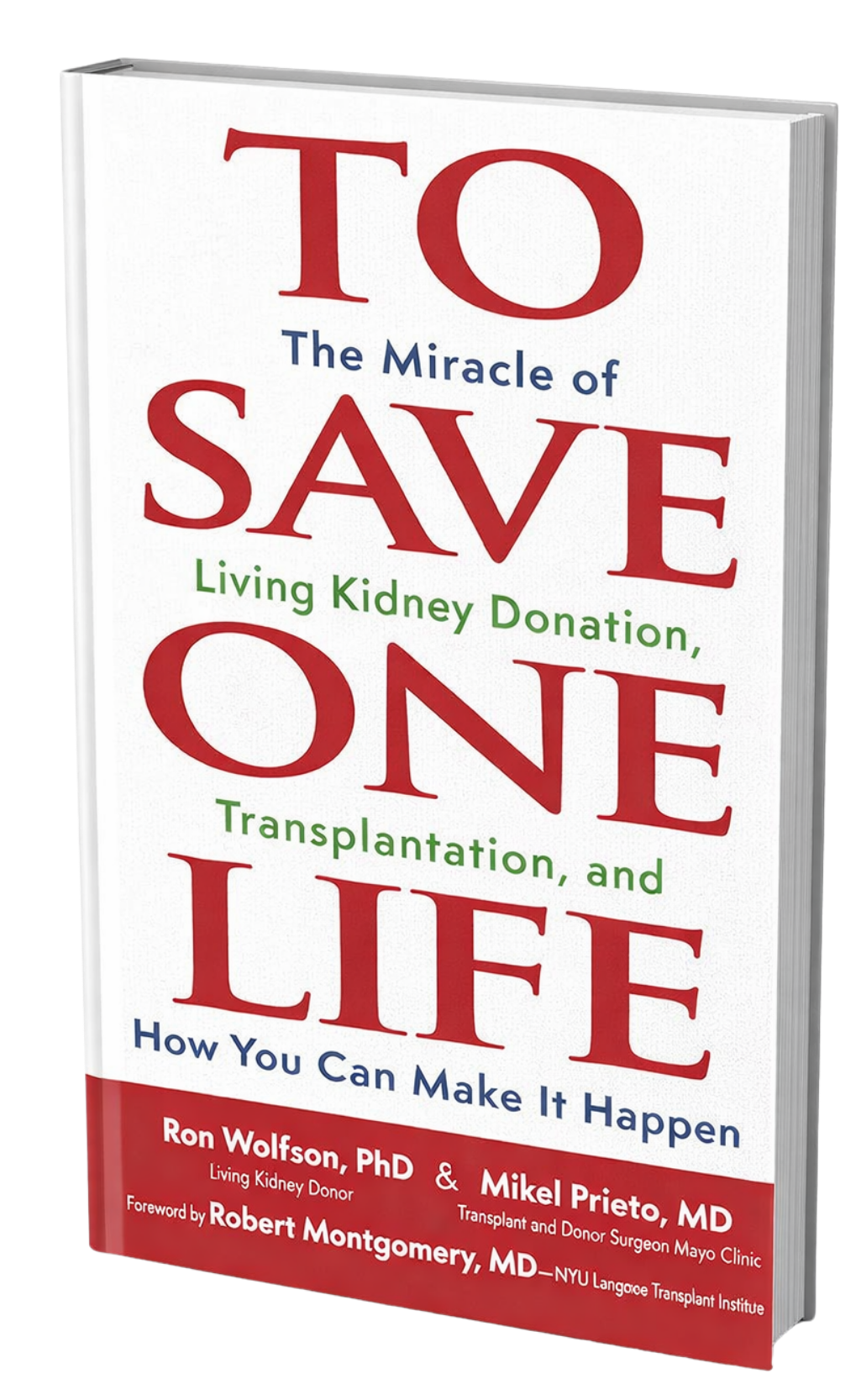
When your congregation signs on to the TSOL campaign, we will send you three complimentary copies of “To Save One Life: The Miracle of Living Kidney Donation, Transplantation, and How You Can Make It Happen,” one for the clergy, one for the liaison to the campaign, and one to share with someone who needs a transplant or is interested in being a living donor.
The ethical guardrails
How we do this work matters as much as that we do it. The Covenant prohibits:
Targeting or personally approaching any person as a potential donor — including by clergy or even the family of someone in need of a kidney.
Using pastoral authority or religious obligation to influence the decision to donate.
Quotas of any kind. Success is not measured by the number of donors produced, but by the number of people we educate.
No financial incentives. Ever.
Choosing not to donate is an equally valid and respected decision. The Covenant holds the campaign to the same standards it asks of every partner.
Every congregation can educate and participate
An estimated 37 million people in the United States suffer from chronic kidney disease; 9 out of 10 are unaware they have it. Nearly 1 million people are in “end stage kidney disease (ESKD)” and will need either a transplant or dialysis to stay alive. 135,000 people enter ESKD every year. 550,000 people are on dialysis.
95,000 are on years-long waiting lists for a deceased organ. Every day, 12 people die waiting and 13 become too ill to qualify for a transplant. With millions more people developing diabetes and/or high blood pressure — the two most prevalent predictors of chronic kidney disease — there is no doubt that every congregation has within its community people who need to know how to educate themselves, their loved ones, and their fellow congregants about how to plan for the “gold standard” for treating ESKD - a preemptive transplant from a living donor. By joining the national TSOL campaign, your congregation agrees to create an annual awareness program, event, and/or sermon about the kidney shortage crisis and what can be done about it.

When someone in your community needs a kidney
A congregant may come to you and say, “I need a kidney. Can you help me?”
Most communities do not know how to respond. We equip you for exactly this moment — how to connect the person with their local transplant center or a national facilitating organization, how to explain the options in plain terms, how to offer pastoral support without overstepping into medical advice.
Often, one person's need becomes the catalyst for a community-wide conversation.

Sign the Covenant
An ethical agreement between your congregation and the campaign.
The Covenant defines our shared principles — your community to educate with integrity, the campaign to provide resources and support, both of us to uphold ethical standards beyond what any law requires.
Read it in full. Discuss it with your leadership.
If you have questions before you sign, contact the campaign.
What the Covenant is:
A mutual promise grounded in shared values.
A commitment to protect the autonomy of every person.
A two-way agreement. The campaign holds itself to the same standards.
What the Covenant is not:
Not a legal contract.
Not a quota target.
Not advocacy for any specific medical decision.
Not a substitute for medical advice.
Become a partner
Whether you’re a faith leader exploring what this campaign could mean for your congregation, someone who wants to learn more about becoming a living kidney donor, someone in need of a kidney transplant, or a potential partner, we’d love to hear from you.